




How to Pack a Leather Weekender for a Two Night Business Trip
Pack a soft weekender in this order: laptop flat against the back panel, heavy and flat along the bottom, hard small objects into the ends and the side pockets, shirts and jackets last and with nothing on top of them. That order does two jobs at once. It keeps the woven garments out from under the weight, and it keeps the bag narrow, which is the dimension a cabin gauge measures.
The reason packing a weekender is a different problem from packing a suitcase is worth understanding before the method makes sense.
In a soft bag, the contents are the structure
A hard case has walls. They hold the shape whatever you put inside, and the shape is the same empty as full. A weekender has no walls. Whatever you load into it becomes its silhouette, which means every packing decision is also a decision about the bag's external dimensions.
That cuts both ways. It is why an overfilled weekender bulges in the middle and stops fitting a sizer it fitted last month. It is also the format's one real advantage: a half-packed soft bag goes into a gauge that a rigid case of the same stated size will not.
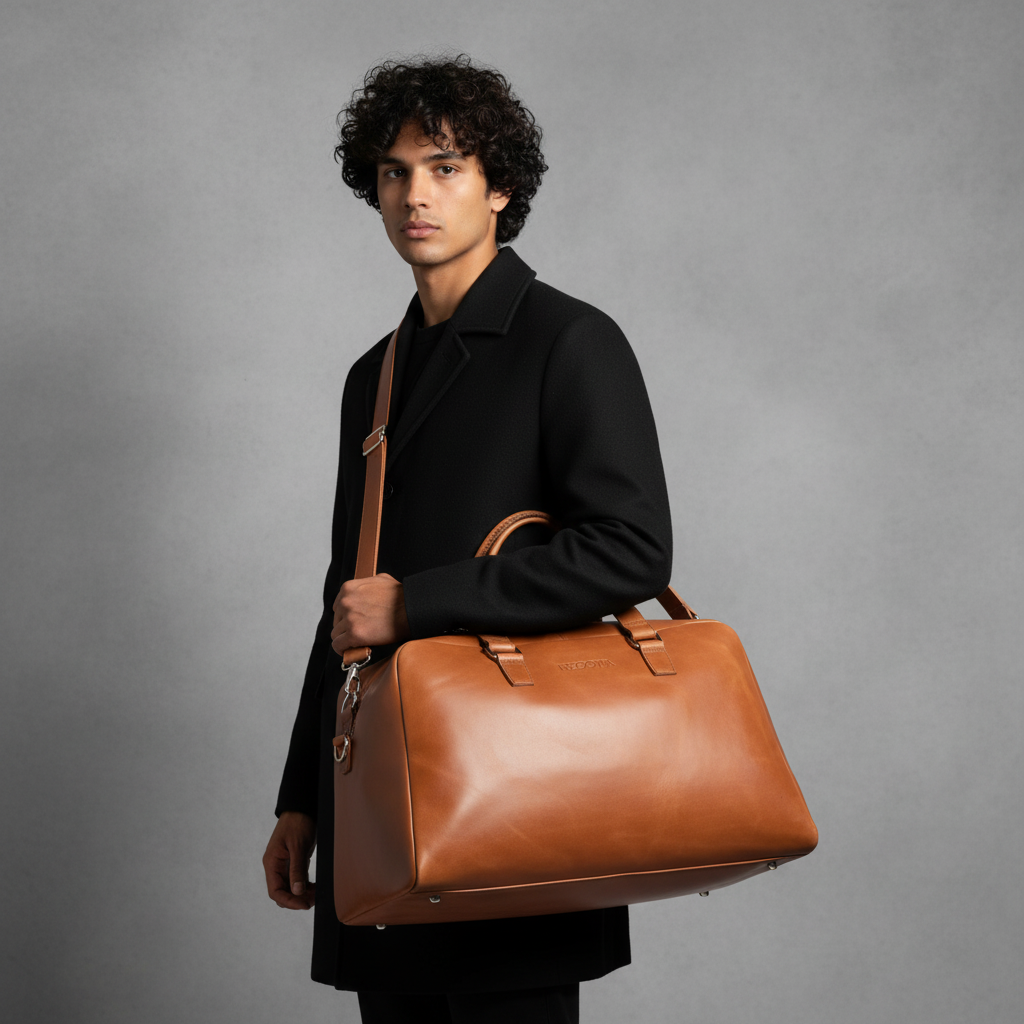
Here is what that means in numbers. Our Marent Weekender is 53 x 24 x 31 cm. Taking its three dimensions in descending order, 53, 31 and 24, against Lufthansa's published cabin allowance of 55 x 40 x 23 cm and 8 kg, it is one centimetre over on the smallest dimension. The Valen Weekender at 49 x 23 x 28 cm sits exactly on that 23 cm line.
Those are measurements of an unpacked bag. A centimetre either way is decided entirely by how you load it. We set out which bags clear which airline in whether a weekender can be your carry-on, and this article is the other half of that: the part you control.
How a crease actually forms
A crease is a fold held under pressure. Pressure and time set it, and warmth and moisture set it faster, which is why a shirt at the bottom of a bag on a two hour train is worse than the same shirt folded on a shelf for a week.
So the useful question is not whether to roll or to fold. It is which folds end up carrying weight. A carefully rolled shirt under six kilos of everything else arrives worse than a roughly folded one on top of the pile. Position beats technique, and it beats it by a wide margin.
Once you accept that, the rest of the method follows on its own.
The order, with the reasoning
1. The laptop first, flat against the back panel
Both weekenders have a padded compartment for laptops up to 16 inches, and it sits against one wall. Put the machine in before anything else, while there is nothing pressing on that plane, and nothing hard goes in beside it afterwards. A charger brick resting against a closed lid for a flight is the most common way a screen gets damaged in a bag that was never dropped.
If the laptop will leave the bag during the trip, a Mantle Sleeve 14 inch at 35 x 25 x 4 cm and 425 g makes it a carry of its own. If it goes in on Tuesday and comes out on a desk on Thursday, you do not need one, and the 425 g is a real cost against an 8 kg allowance.
2. A flat base layer, laid lengthwise
Trousers, knitwear and anything heavy go in next, along the bottom of the bag, laid out lengthwise rather than bunched into a corner. Two reasons. Weight at the bottom keeps the bag upright when you set it down, and a flat layer is what the rest of the pack sits on. Bunch this layer and every garment above it inherits the lumps.
Roll the knitted things here. A rolled jumper has nothing in it that can take a crease, and rolling genuinely saves space on knitwear. Save folding for the woven garments, which come later.
3. Hard objects into the ends, not the middle
This is the step most people skip and it is the one that decides whether the bag passes a gauge.
A weekender is long. Both of ours are roughly half a metre. The two ends are dead space that clothing does not naturally reach, and anything you put there adds nothing to the bag's width. Anything you put in the middle adds to the width twice, because it pushes both sides out.
So chargers, cables, a shoe, a book, the things with corners: ends and side pockets. The Marent has two side pockets, a front zip pocket, a tablet sleeve and a phone pocket, which is enough to take every hard small item out of the main compartment entirely. The Valen handles it differently, with dedicated compartments for a charger, a passport and a notebook, plus a pen holder and hidden compartments for an AirTag and AirPods. Same principle, different arrangement.
Shoes, if you take a second pair, go at one end with the soles facing outward and socks stuffed inside them. Soles outward keeps them off the clothing, and the socks stop the shoe collapsing and wasting the space.
4. The wash bag flat against the back panel
Not in a side pocket. A wash bag is the densest object in the pack and a side pocket is the worst place for it, because that is precisely where it adds width. The Caldre Wash Bag is 23 x 11 x 11 cm and the Mori Wash Bag is 24 x 13 x 10.5 cm, both 355 g empty. Lying flat next to the laptop, either one disappears into the pack. Pressed into the side of the bag, the Mori's 13 cm is most of your margin on a 23 cm limit.
5. Shirts and jackets last, and nothing on top
Woven garments go in at the end, on the flat surface everything else has made, and nothing goes on top of them. That is the single highest-value rule in the whole method.
Fold a shirt along seams it already has. The placket and the sleeve seams are folds the garment was built with, so creases that follow them read as the shirt rather than as the packing. Fold across the back once, sleeves in along the shoulder seams, and stop there. Every extra fold is an extra crease you chose.
For a jacket, length matters more than volume. Both weekenders are around 50 cm internally, and a jacket folded once across the middle fits that without a hard crease through the chest. Fold it twice and the second fold lands where you will see it.
The bundle method is worth knowing if you carry more than one woven garment. Lay the jacket flat, the shirts on top of it, and wrap the whole set around a soft core of the knitwear, so there is no single tight fold anywhere in the bundle. In a hard case this is fiddly. In a weekender it works well, because the bag takes the bundle's shape instead of forcing its own.
What this leaves you with
On a 2 to 3 night trip with a laptop and a wash bag, the result is a bag that is flat across its width, heavier at the bottom than the top, with every hard object at an end. It will be at or under its listed dimensions rather than over them, and the shirt on top will need hanging up rather than pressing.
On weight, the arithmetic is less forgiving and worth doing before you pack rather than at a bag drop. The Marent is 1,950 g empty and the Valen 1,600 g. Against Lufthansa's 8 kg cabin limit that leaves 6.05 kg and 6.4 kg for contents. KLM works differently: its hand baggage allowance is 55 x 35 x 25 cm including handles and wheels, and the 12 kg in Economy and Premium Comfort is a combined figure for the cabin bag and the small bag together, so the number to watch is the total of both. We ran the same arithmetic from the volume side in what size weekender you need for a 2 or 3 night trip.
Four things that work better than any packing technique
We would rather say these than sell you a method that cannot deliver what it promises.
Choose the fabric. A travel weight wool or a treated cotton arrives wearable from a badly packed bag. A pure linen shirt does not arrive uncreased from any bag by any method, and no amount of folding changes that. If creasing is your recurring problem, the answer is in your wardrobe rather than in your packing.
Use the bathroom. Twenty minutes on a hanger in a steamy bathroom removes more creasing than an hour of careful folding prevents. It costs nothing and it works on almost everything.
Wear the jacket. The structured garment you are most worried about creasing is the one you can simply not pack. It also buys you back several litres, which on a 32 litre bag is the difference between comfortable and sat-on.
If you travel in a suit every week, buy a garment bag. A dedicated garment carrier keeps a suit flat and hanging, and nothing you do inside a weekender matches it. We do not make one. If that is your pattern of travel, the honest advice is that this is the wrong format for the suit, whatever else the bag is good for.
Two things not to do
Do not use the laptop compartment for anything other than the laptop. It is the one flat plane in the bag and it is tempting as a document slot, but whatever you put there presses against the screen for the whole journey.
Do not overfill to use up the stated litres. The 35 and 32 litre figures are capacity, not a target. A weekender filled to its rating is wider than its listed dimensions and heavier than you want to carry through a terminal, and on a soft bag the width is the thing that gets measured. If you are consistently filling it, you needed the next size up or the hold.
If the bag arrives creased anyway
The leather will take marks from a trip too, and those are a different matter from creases in a shirt. Pressure lines in nappa leather usually settle out on their own once the bag is unpacked and standing. Our notes on caring for a leather bag cover what to do, and more usefully what not to do, since most leather damage comes from over-treating rather than from travel.
The short version
- Laptop first, flat against the back panel, nothing hard beside it.
- Heavy and flat along the bottom, laid lengthwise. Roll the knitwear here.
- Hard objects into the two ends and the side pockets. Never the middle.
- Wash bag flat next to the laptop, not in a side pocket.
- Shirts and jackets last, folded on existing seams, with nothing on top.
- Position beats technique. A rough fold on top beats a perfect roll underneath.
- Subtract the empty bag from the weight allowance before you plan the contents.
- Fabric choice and a steamy bathroom outperform all of the above.
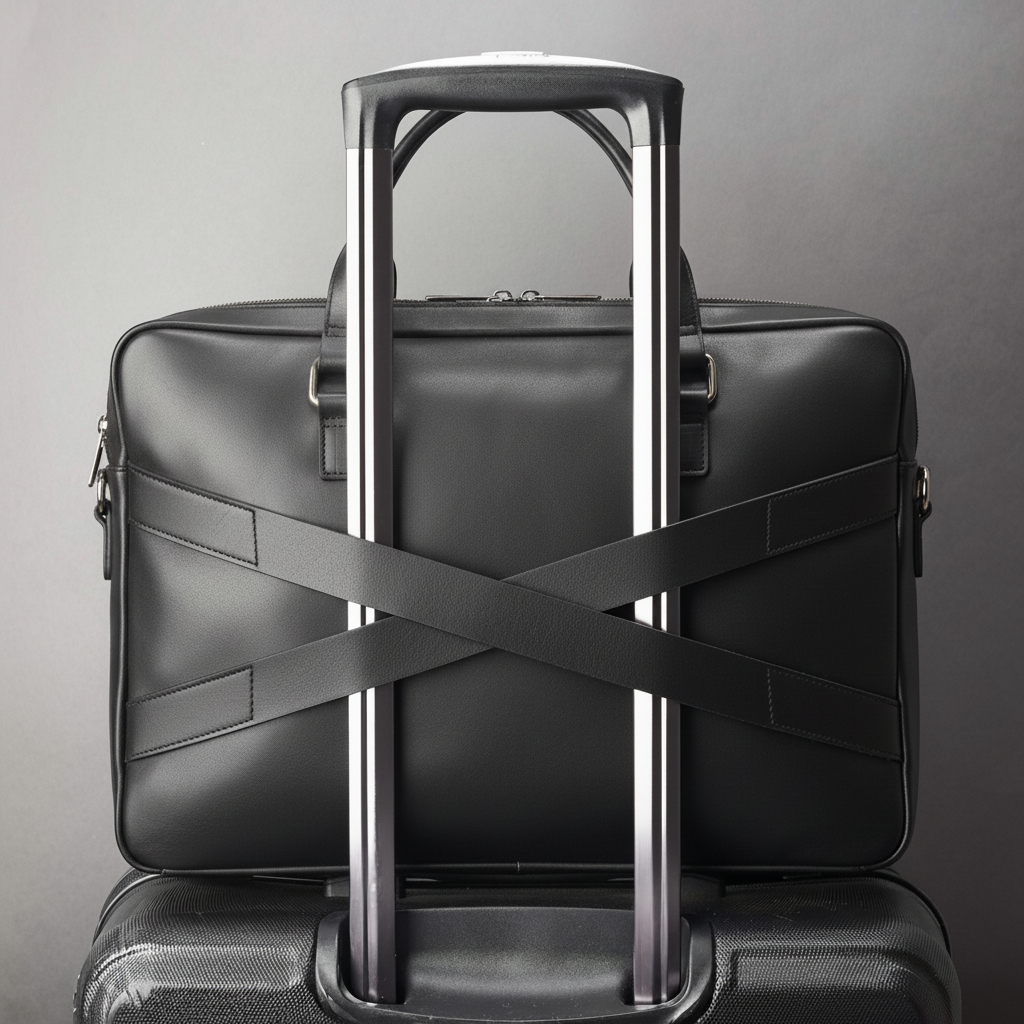
Both bags sit in the Weekenders collection, and the two wash bags in wash bags. If your question is the smaller one, whether the bag you carry to your seat counts against your allowance at all, that is whether a laptop bag counts as a carry-on or a personal item.
Lufthansa and KLM cabin allowances read from each airline's own baggage pages in October 2026. Allowances change and vary by fare, so check your own booking. Bag dimensions, capacities and weights as listed on each product page. Remaining-weight figures calculated from the listed empty weights.


