



Do You Still Have to Take Your Laptop Out at Airport Security?
Short answer: at a growing number of European airports, no. Your laptop can stay in your bag. But the rollout is uneven, the rules can differ between two terminals of the same airport, and occasionally between two gates in the same terminal. So the useful answer is not a rule. It is a way of packing that works whichever lane you end up in.
What actually changed
Older cabin baggage scanners produce a flat X-ray image. A laptop is dense and roughly the size of the bag it sits in, so it blocks the view of everything behind it. That is the entire reason you were asked to take it out. It was never about the laptop being suspicious. It was about it being opaque.
The newer machines use computed tomography. They build a three-dimensional image that staff can rotate and inspect from any angle, so a laptop no longer hides anything. Once an airport installs them, the requirement to remove electronics disappears, and in most cases the 100 ml liquid limit relaxes at the same time.
Where it stands right now
Two examples worth knowing, because together they show why a single rule does not exist.
Amsterdam Schiphol has fitted its departure and transfer filters with CT scanners. Laptops, tablets and liquids stay in the bag. You put your hand baggage in a tray and walk through. There is no separate step.
Frankfurt is the more instructive case. Frankfurt Airport states that CT scanners are in use at most Terminal 1 checkpoints and at all Terminal 3 checkpoints, and that laptops, tablets and cameras can stay in hand luggage there. It then lists where the old rules still apply: gates C1, C2, C4 and C6, certain special checkpoints in Terminal 1, and the transfer checkpoints used by connecting passengers. The airport's own advice is to check your departure gate first, because you cannot tell in advance which lane you will pass through.
That is the honest state of things across most of Europe in 2026. The direction is clear and the endpoint is obvious, but the middle of a rollout is messy, and transfer checkpoints tend to be last in line. If you connect through an airport rather than starting there, assume the old rules.
Two more reasons not to get comfortable. Rules on a return leg from outside the EU are a separate matter entirely. And at some airports the new lanes opened on priority or fast track lines first, so whether your laptop stays in the bag can come down to which fare you bought.
Pack as if you will be asked
This is the part that is actually within your control, and it is worth more than knowing any individual airport's current status.
The cost of being asked to remove a laptop is not the removing. It is the unpacking around it: lifting out a charger that sits on top, unzipping a compartment that only opens partway, finding the machine wedged behind a folder. People who travel often are not faster because they know the rules. They are faster because their bag only requires one motion.
Four things make that true:
- The laptop has its own compartment, reachable from the outside. If getting to it means going through the main compartment, everything in the main compartment is now part of the operation.
- That compartment opens far enough to lift the laptop straight up. A zip that stops two thirds of the way along means angling the machine out, which is slow and is how corners get knocked.
- Nothing hard is stacked on top of it. A charger, a power bank or a bunch of keys sitting above the laptop has to be moved before the laptop can move. Keep them in a separate pocket. This is worth doing anyway, because hard objects pressing on a closed lid are one of the quieter ways screens get damaged.
- Your hands are free before you reach the belt. If the bag is on your shoulder while you are also handling a suitcase, boarding pass and jacket, the queue is where you find that out.
The cheapest fix is usually not a new bag
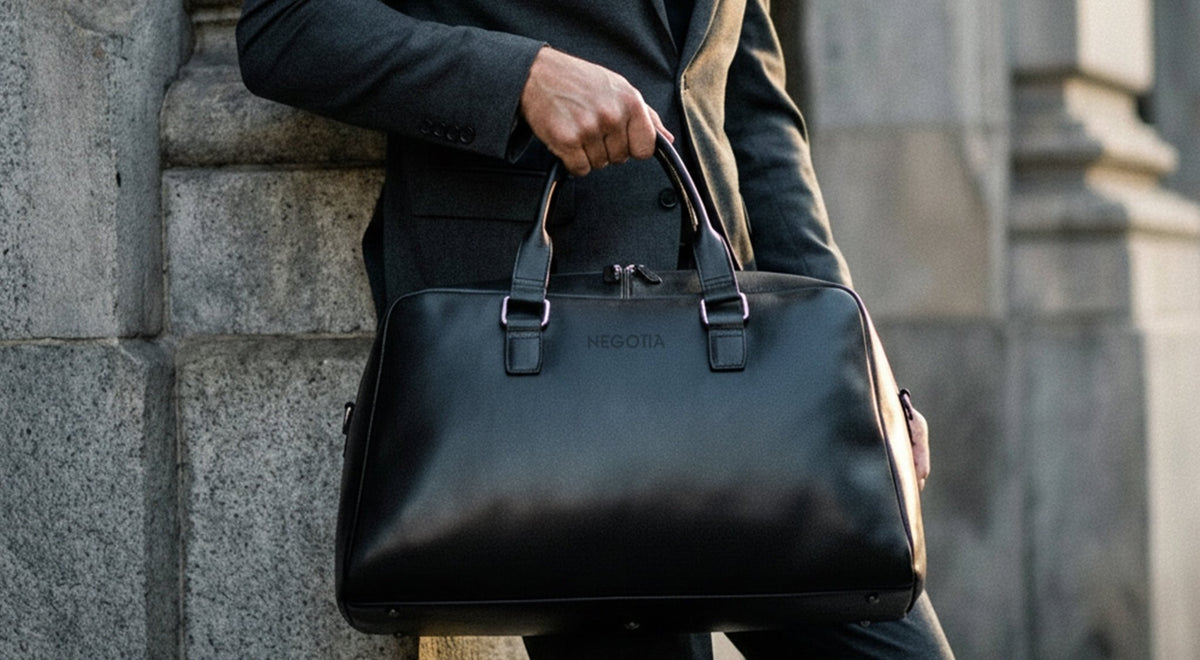
Worth saying plainly, since we sell bags: if your current bag already has a usable laptop compartment, you do not need a different one. Move the charger and cables to a front pocket, and you have fixed most of the problem for nothing.
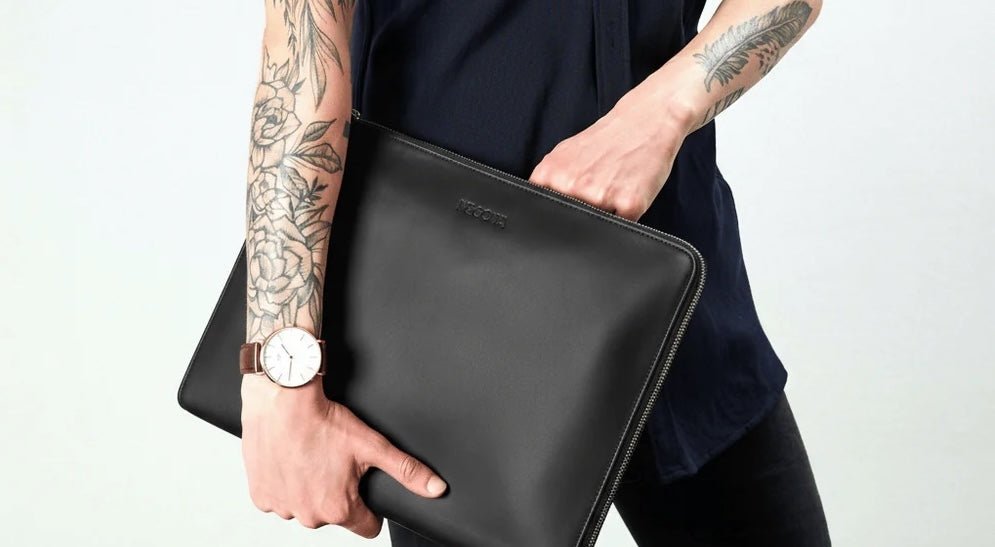
The second cheapest fix is a sleeve. A laptop in a sleeve inside a larger bag comes out as one object, goes into the tray as one object, and is still protected when it is out of the bag and sitting on a tray that fifty other bags have been through. The Mantle Sleeve 14" is 35 × 25 × 4 cm and 425 g, with a padded compartment for laptops up to 14 inches, a separate compartment for a Magic Keyboard and a pocket for a phone or mouse, in nappa leather with YKK zips. At €69 it is a smaller decision than replacing a bag, and it works inside whatever you already carry.
If you are choosing between formats rather than adding to what you have, our comparison of a sleeve, a folio and a briefcase sets out what each one actually protects against.
If you fly often, the luggage sleeve matters more than you think
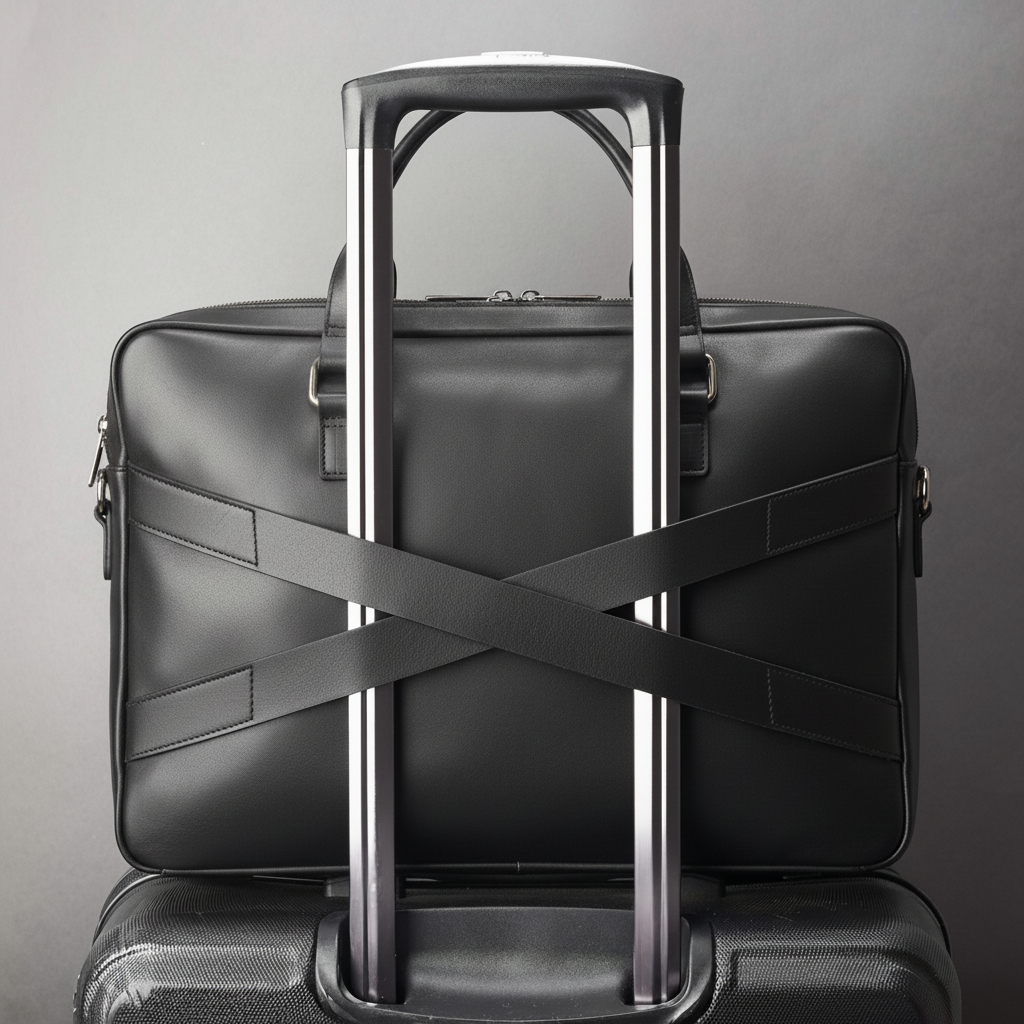
The single most useful feature on a bag for air travel is not the laptop compartment. It is the sleeve on the back that slides over a suitcase handle. It takes the weight off your shoulder for the walk to the gate, keeps the bag upright and stable, and means that when you reach security you lift one item off the suitcase rather than untangling two.
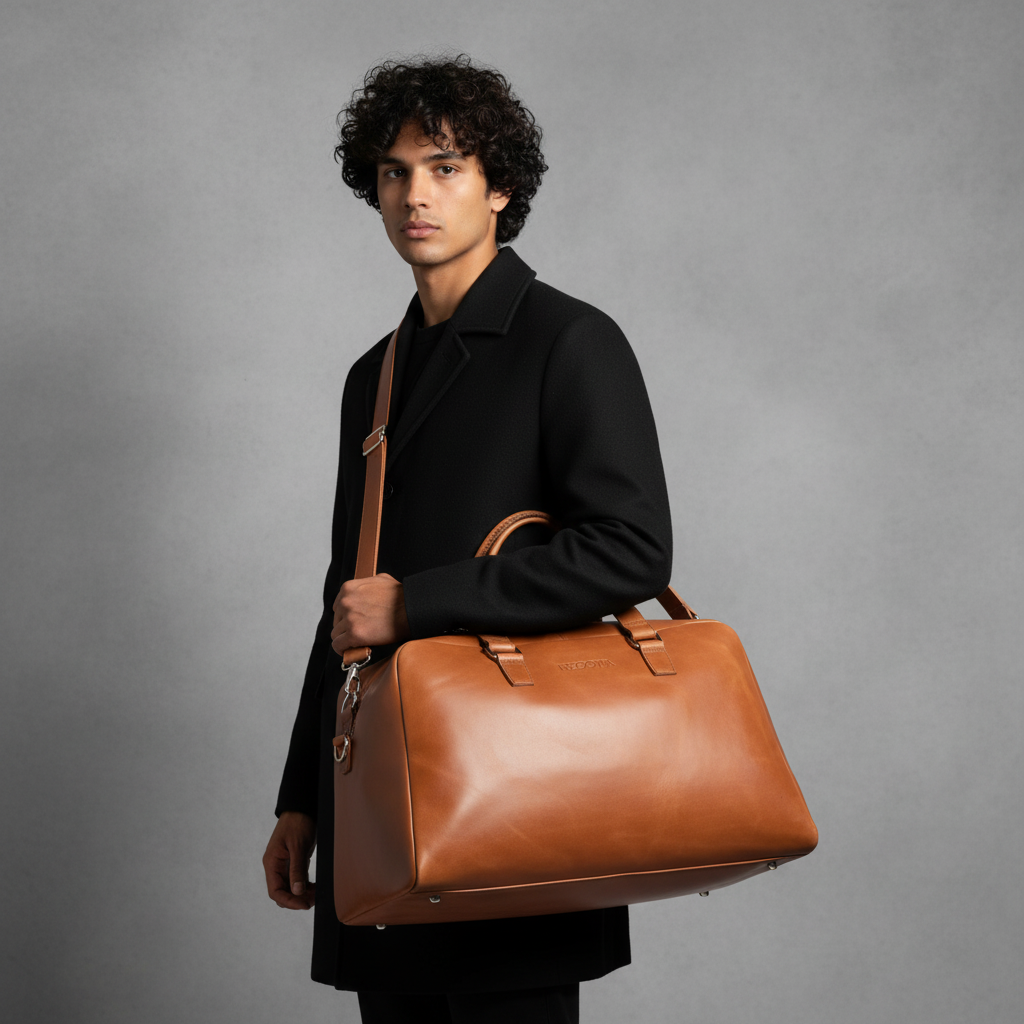
The Sorel Briefcase is built around that: 42 × 30 × 8 cm, 1,200 g, a padded compartment for laptops up to 16 inches, a dedicated tablet compartment, a front zip pocket for the charger and an internal zip pocket, plus a luggage sleeve and a detachable adjustable shoulder strap. It is €169. The 8 cm depth is the relevant number for travel: slim enough to sit under a seat in front, structured enough that the laptop is not pressed against whatever else is in the bag.
A fair caveat. At 1,200 g empty it is a real bag, and if you fly on a basic fare where the only free item is a small under-seat bag, measure before you assume it qualifies. Cabin allowances vary by airline and by fare, and they change. Check the airline's own page rather than a summary of it.
A short checklist
- Check your departure gate or terminal if the airport publishes which checkpoints have CT scanners.
- Assume the old rules if you are connecting rather than starting your journey there.
- Put the charger, power bank and cables in a pocket that is not the laptop compartment.
- Keep the laptop reachable without opening the main compartment.
- If you use a sleeve, it comes out as one piece, so nothing else needs to move.
- Free your hands before the belt, not at it.
The point
The rules are moving in one direction and will keep moving. Within a few years the question in this title will stop being asked. Until then, the reliable approach is not to track which airport has which machine. It is to carry a bag that makes the answer irrelevant, so that being asked costs you three seconds instead of three minutes.
Getting the fit right matters first: if you are not sure which size you need, the MacBook sleeve size guide lists current models against sleeve sizes. The full range sits in the bags collection.