




A leather bag in rain, salt and cold: what to actually do
Short answer first, because it is November. Rain on a finished leather bag is rarely the problem. The problem is the hour afterwards, when a wet bag goes on a radiator or in front of a hair dryer. Heat dries leather faster than it can recover, and leather that dries too fast comes back stiff, slightly shrunken and ready to crack along its creases. The damage is almost always done in the drying, not in the wetting.
This is the seasonal companion to our general guide on how to care for a leather bag. That one covers the whole year. This one covers November to March in northern Europe, which means rain, road salt and cold.
What rain actually does
A smooth finished leather such as nappa has a treated surface. Light rain sits on top of it in beads for a while before anything gets through, which is why a ten minute walk to the station usually leaves no trace. Longer or heavier rain gets past the finish, and water moves into the fibres. As it evaporates it carries some of the oils in the leather out with it, and it can leave a faint line where the wet area ended.
None of our bags is sold as waterproof, water resistant or weatherproof, and we are not going to describe them that way. Leather is a natural material with a finish on it, not a membrane.
The evening it gets soaked, in order
- Empty it completely. Paper, a laptop, a notebook, anything damp held against the lining will keep the inside wet for hours longer than the outside.
- Blot, never rub. A dry towel or a clean cloth, pressed on and lifted off. Rubbing a wet finish moves water sideways and spreads the mark you are trying to avoid.
- Open everything. Zips, flaps, inner pockets. Air has to reach the lining, not just the outside.
- Stuff it loosely. Plain paper or a towel, enough to hold the shape, not enough to stretch the panels. Newsprint can transfer ink to a pale lining, so use something clean.
- Dry it at room temperature, away from every heat source. No radiator, no hair dryer, no heated floor, no hot car. A normally heated room with some air movement is right.
- Let it take as long as it takes. Hours for a shower, considerably longer for a bag that was properly soaked. It is dry when the leather feels room temperature rather than cool to the back of your hand.
- Condition afterwards, not during. A conditioner on damp leather traps the moisture. Wait until the bag is dry, then treat it, because a soaking does remove some of what keeps the leather supple.
| What happened | Do this | Do not |
|---|---|---|
| Caught in a shower | Blot it dry, stand it up, leave it out overnight | Put it straight back in a cupboard while damp |
| Soaked through | Empty, blot, stuff loosely, open all zips, dry slowly at room temperature | Radiator, hair dryer, heated floor, direct sun |
| White salt marks | Lift them with a barely damp cloth the same day, then dry with a clean one | Brush or scrub dry salt across the surface |
| A tide line after drying | Even out the whole panel with a barely damp cloth, then let it dry evenly | Treat only the mark, which usually makes a second edge |
| Bag left in a freezing car overnight | Bring it inside and let it warm up before you load it | Force a laptop into cold, stiff leather |
| Wet every single day | Carry something else on those days | Assume care products will solve a daily soaking |
Water marks, and what can be evened out
Most marks are not damage, they are edges. Water darkens leather while it is in there and lightens again as it leaves, and the visible line sits exactly where the wet part stopped. Because it is a boundary rather than a stain, treating the mark alone tends to create a new boundary slightly further out. Working the whole panel with a barely damp cloth, then drying it evenly and slowly, usually makes the line disappear or fade to something you have to look for.
What does not come back is heat damage. Leather dried hard stays stiff, often a shade duller, and cracks at the creases where it flexes. Conditioner improves the feel and does not undo it.
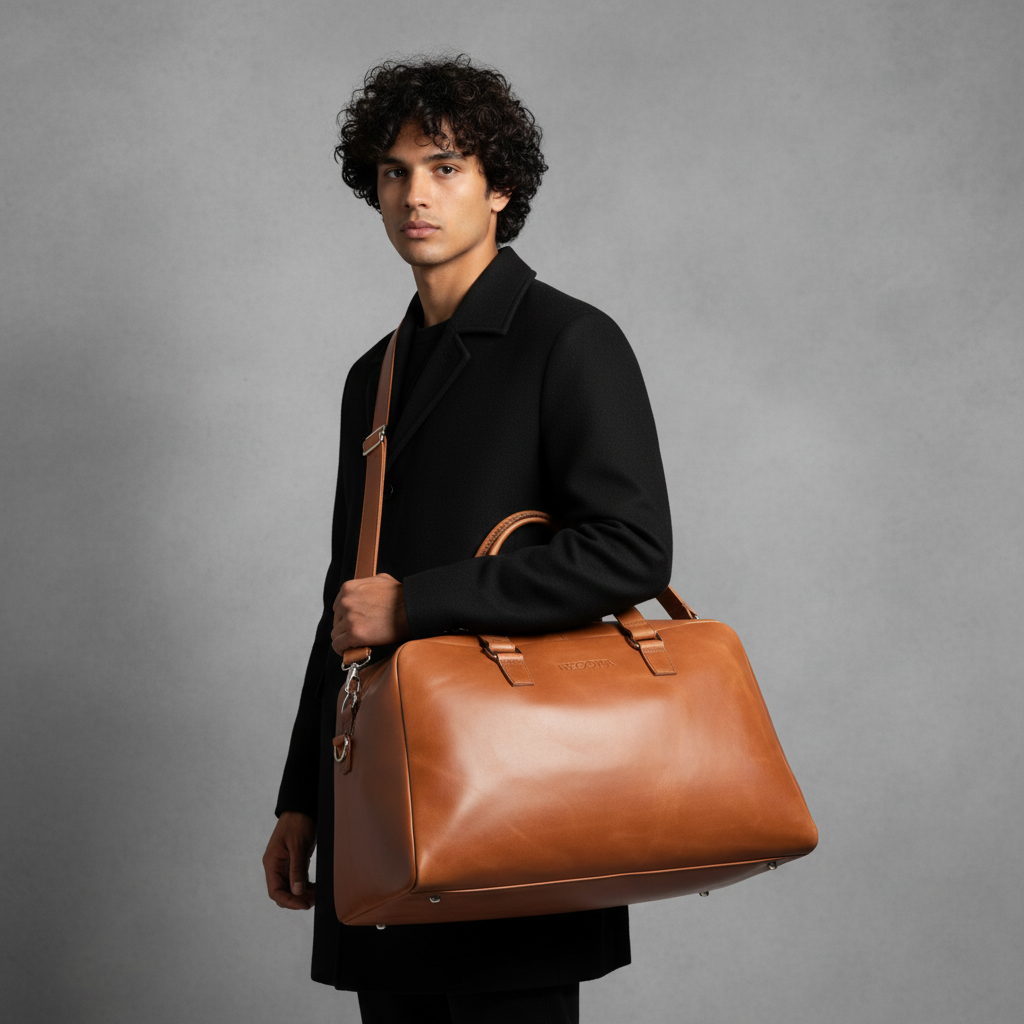
Structure helps. A bag with a defined shape, like the briefcases and backpacks in our leather bags collection, holds its form while it dries. A soft bag left wet in a heap dries into the shape of the heap.
Road salt, which nobody warns you about
From December onwards, pavements, tram stops and station forecourts in the Netherlands, Germany and Poland are salted, and that salt ends up on the base and lower corners of any bag set down on a wet floor. It shows as pale, slightly crusty streaks once the leather dries, and it is more pressing than rain, because salt holds moisture and keeps pulling it out of the leather for as long as it sits there.
Deal with it the same evening. A barely damp cloth, dabbed rather than dragged, lifts the salt, because salt dissolves. Then a dry cloth, then air. What you avoid is attacking dry salt with a brush, because the crystals are abrasive and you would be grinding them across a finished surface. If the base of your bag takes this every winter, check it weekly rather than waiting for marks.
Cold on its own
Leather stiffens as it gets cold. The temperature is not harming it, but stiff leather creases differently: it folds in a hard line instead of a soft one, and that hard line is where cracking starts later. So a bag that spent the night in a freezing car boot should come inside and reach room temperature before you push a laptop into it or snap a flap shut over an overpacked compartment. It costs time and no effort, and it is the cheapest winter care there is.
Should you proof it before winter?
This is a genuine trade off rather than an obvious yes, and anyone who tells you to spray every bag in October is not thinking about what it costs. A proofing spray changes how the surface takes water. It also changes the surface, which means it can change how the bag looks and how its patina develops.
| Consideration | Proofed | Untreated |
|---|---|---|
| Light rain | Beads and sits longer before anything soaks in | Gets through sooner in sustained rain |
| Surface | Can read slightly flatter or more matte | Unchanged |
| Patina | Develops more slowly and more uniformly | Develops openly, marks included |
| Salt and street dirt | Tends to lift more easily | Lifts fine, with more care |
| Upkeep | Needs renewing during the season | Nothing extra |
No spray makes a leather bag waterproof, so treat it as changed surface behaviour, not protection. Test a hidden area first, the base or under a flap, and look at it dry before you commit to the whole bag. Cognac shows a tonal shift more readily than black. And if you bought the bag partly to watch it age, consider leaving it alone.
The honest part
A leather bag is the wrong bag for a daily soaking. If you cycle to work through Dutch or German winter rain every morning, uncovered, leather will be wet again before it has finished drying from yesterday, over and over, all season. That pattern is the one thing it does not take well, and no spray and no routine fixes it.
Carry something technical on those days. Keep the leather for the train, the office, the client meeting and the many days that are merely grey. That is not a smaller life for the bag, it is the bag lasting a decade instead of two winters.