



Leather vs Neoprene Laptop Sleeve: Which Protects Better?
Neither material is doing the protecting. The padding is.
That single fact resolves most of this question. A leather sleeve and a neoprene sleeve both wrap your laptop in a layer of foam, and that foam absorbs the impact. What the outer material decides is different: how much water the sleeve shrugs off, what it weighs, whether it keeps its shape after a year in a full bag, and what it looks like when it is no longer new.
So the honest comparison is not "which is stronger". It is which set of trade-offs suits the way you actually carry a laptop.
What a laptop sleeve is actually made of
Almost every padded sleeve is three layers. An outer shell, a padding layer, and a lining against the machine.
Neoprene sleeves usually collapse those three into one. Neoprene is a closed-cell synthetic rubber, so the shell and the padding are the same piece of material, typically 3 to 5 mm thick, with a knit face bonded to each side. That is why a neoprene sleeve is so light and so thin for the cushioning it gives.
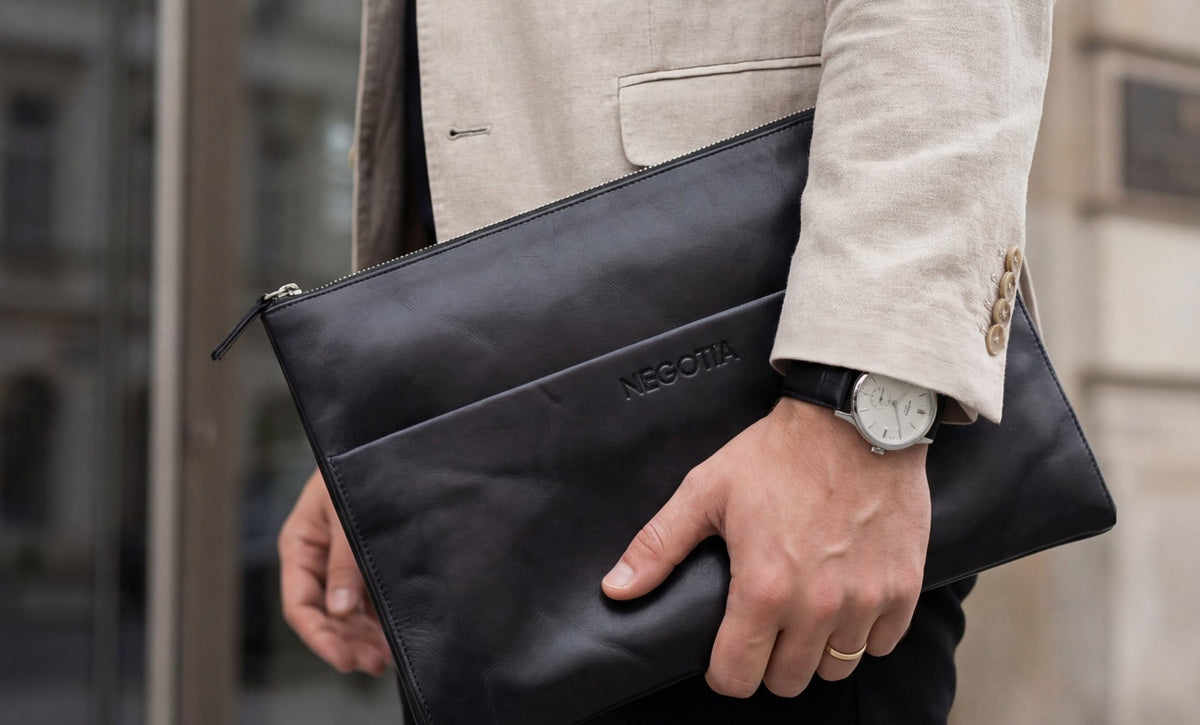
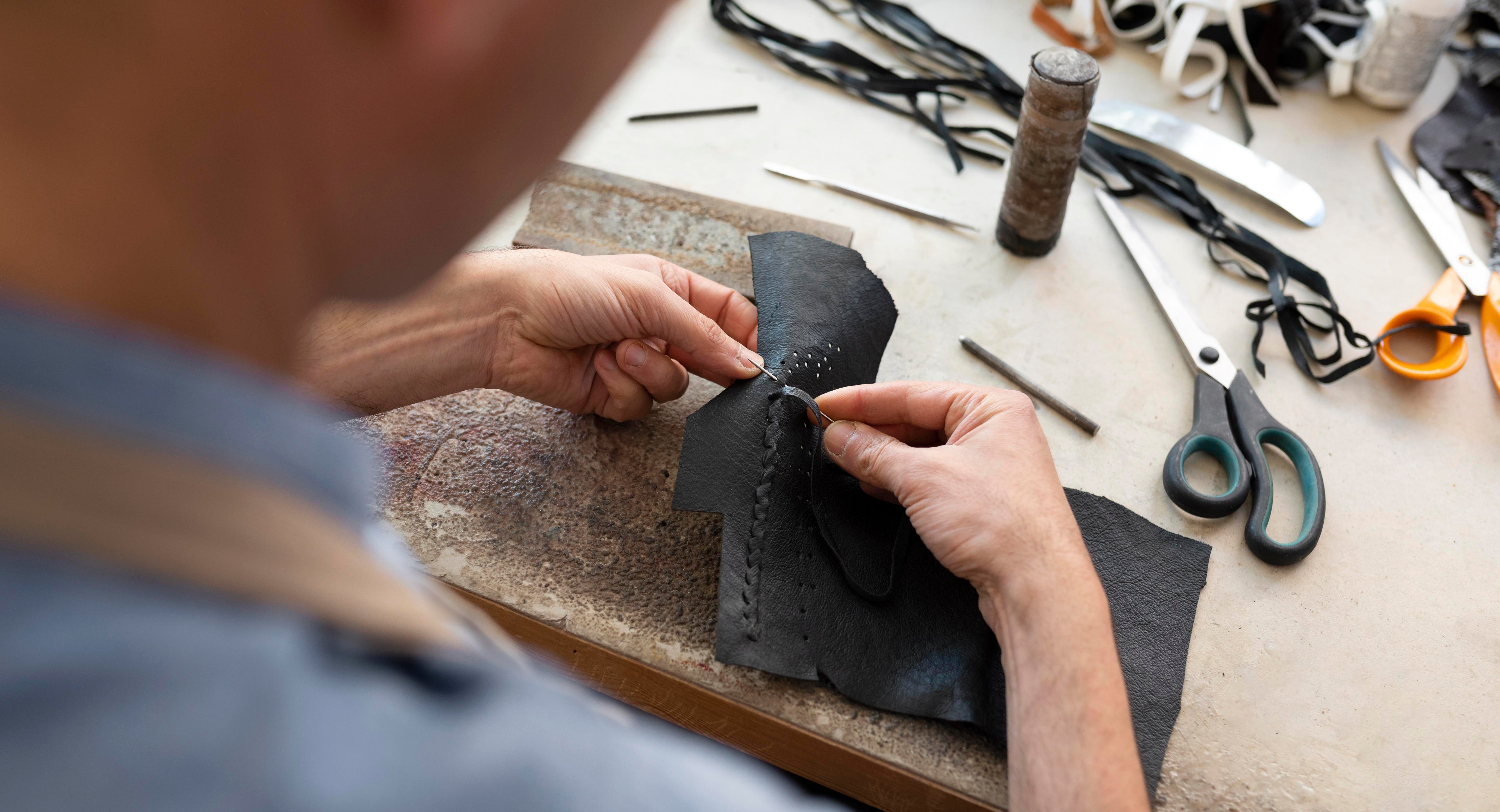
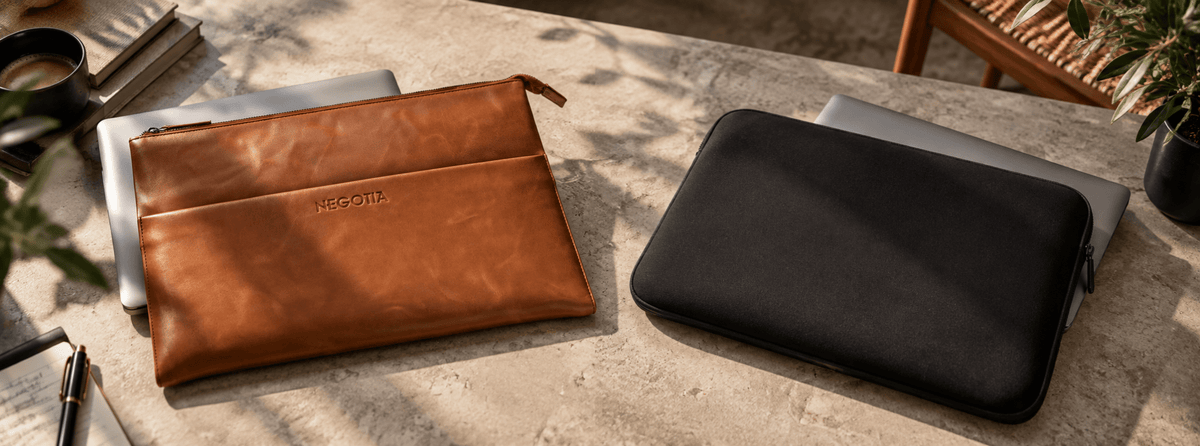
A leather sleeve separates them. The leather is a skin, not a cushion, and it sits over a dedicated foam layer with a fabric lining inside. Our own sleeves are built this way: nappa leather outside, a padded laptop compartment, cotton lining, YKK zips.
This is the structural difference everything else follows from. One material doing three jobs, or three materials each doing one.
Where neoprene genuinely wins
Water. This is not close. Closed-cell neoprene does not absorb water, which is the property that makes it wetsuit material. Rain on the walk from the car, a drink knocked over on a desk, a damp train seat: neoprene handles all of it and dries without marking. Leather does not. Leather tolerates light rain and will survive being caught out, but water sits on it, can leave a mark as it dries, and repeated soakings dry the fibres out. As our guide on how to care for a leather bag sets out, the maintenance is not onerous, but it is not zero either.
Weight. Neoprene is lighter for the same amount of cushioning, because it is not carrying a separate shell. If you are already at the limit of what you want on your shoulder, that difference is real.
Price. A neoprene sleeve costs a fraction of a leather one. If a laptop sleeve is a consumable to you, something you expect to replace when it gets tired, neoprene is the rational purchase and nothing here argues otherwise.
Stretch. Neoprene gives a little, so a single size covers a wider range of machines. A leather sleeve does not stretch, which means it has to be sized properly.
Where leather genuinely wins
It keeps its shape. Foam under sustained load takes a set. Compress a neoprene sleeve between a charger and a water bottle in a packed bag every day for a year and the foam does not fully rebound. It thins at the pressure points, which are exactly the points you wanted padding. The sleeve still looks fine from the outside. It is simply doing less than it did. A leather sleeve with a separate padding layer spreads load across a panel that resists deformation on its own, so the foam inside is not the only thing holding the shape.
Abrasion. The knit face on a neoprene sleeve pills, catches and eventually fuzzes, particularly at the corners and along the zip. It is cosmetic, but it is also the visible clock on the product. Leather scuffs instead of pilling, and a scuff on nappa leather burnishes rather than frays.
It ages rather than wears. This is the part that is hard to argue on a spec sheet and obvious after three years. Neoprene has one good state and declines from it. Leather has a long second life where it looks used rather than worn out. If you want to understand what is happening to the surface, what nappa leather is explains it plainly.
Edges and closure. A leather sleeve at this level typically comes with a proper zip and stitched, finished edges. Neoprene sleeves often use a lighter zip set into a bonded seam, and that seam is the usual failure point.
The thing that outranks the material
Fit matters more than what the sleeve is made of, and it is not close.
A sleeve that is too large lets the laptop move. Once it moves, it arrives at the seam with momentum, and padding cannot absorb speed it never had a chance to slow. A well-fitted neoprene sleeve protects a laptop better than a loose leather one, and the reverse is equally true.
This is where the stretch in neoprene cuts both ways. It forgives an approximate size, which is convenient, but it also means people buy approximately. A leather sleeve has to be matched to the machine, which sounds like a drawback and mostly is not, because the result is a sleeve that actually grips.
If you are sizing one now, our MacBook sleeve size guide matches each current model to a size, and how to measure your laptop covers the method for everything else.
Side by side
| What you are judging | Neoprene | Leather |
|---|---|---|
| Impact absorption | Good, from the material itself | Good, from a dedicated padding layer |
| Water | Water-resistant by nature | Tolerates light rain, not waterproof |
| Weight | Lighter | Heavier |
| Holding shape over years | Foam thins at pressure points | Panel resists deformation |
| Surface wear | Pills and fuzzes | Scuffs and burnishes |
| Sizing | Stretches, forgiving | Must be matched to the machine |
| Maintenance | None | Occasional conditioning |
| Cost | Low | Higher |
| Suits | Wet commutes, light carry, replaceable | Daily professional carry, kept for years |
How to decide, in one question
Ask whether this sleeve is a consumable or a possession.
If you cycle to work in Dutch weather, throw the sleeve in a gym bag, and expect to replace it when it looks tired, buy neoprene and spend the difference elsewhere. That is a coherent answer and there is no reason to talk you out of it.
If the laptop is what you work on, the sleeve is visible in front of clients and colleagues, and you would rather buy once, leather is the better economics as well as the better object. The condition is that you size it properly and accept that it wants wiping down and conditioning once or twice a year.
The NEGOTIA sleeves, with real numbers
| Product | Fits | Dimensions (W x H x D) | Weight | Price |
|---|---|---|---|---|
| Mantle Sleeve 14 inch | Up to 14 inch | 35 x 25 x 4 cm | 425 g | € 69 |
| Mantle Sleeve 15.6 inch | Up to 15.6 inch | 40 x 28 x 4 cm | 485 g | € 74 |
| Notion Folio 14 inch | Up to 14 inch | 35 x 25 x 4 cm | 425 g | € 79 |
| Notion Folio 15.6 inch | Up to 16 inch | 40 x 28 x 4 cm | 475 g | € 84 |
All four are nappa leather over a padded laptop compartment, cotton lined, with YKK zips. The Mantle sleeves keep it to the laptop plus a notebook, chargers, a compartment for a Magic Keyboard and a pocket for a phone or mouse. The Notion folios add structured organisation at the same footprint and almost the same weight, which is worth knowing: the folio is not a heavier or more protective product, it is a better organised one.
If you are still choosing between formats rather than materials, sleeve vs folio vs briefcase sets out what each one actually protects against. The full range sits in the bags collection.
One last thing
If your bag already has a padded laptop compartment, the material question may be moot, because you might not need a sleeve at all. We wrote about whether a sleeve inside a backpack earns its place rather than let people buy two things that do the same job.